
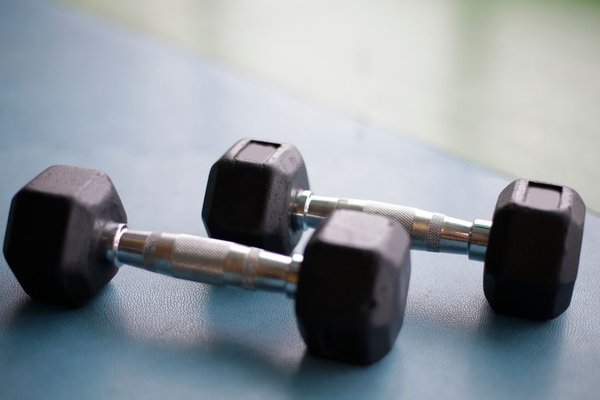
A pair of dumbbells can do more than fill a corner of your living room. With a clear plan, they can help you train your legs, hips, back, chest, shoulders, arms, and core without a bench or a rack of equipment. The trick is not collecting dozens of exercises. It is choosing a few movements that complement one another and repeating them consistently.
This dumbbell workout at home is built for a small space and an ordinary pair of weights. You will learn how to set up a full-body session, adjust it to your ability, and make progress even if your dumbbells are not adjustable.
Set up a routine you can actually repeat
Before lifting, spend five minutes marching briskly, circling your arms, practicing unweighted squats, and hinging at your hips. Then try a few easy repetitions of your first exercise. A warm-up should prepare you to move, not exhaust you.
Choose dumbbells that make the final two or three repetitions feel challenging while your form stays controlled. You may need a lighter weight for shoulder presses than for squats. If you own only one fixed pair, adjust repetitions and tempo rather than forcing the same effort on every movement. For more help, explore our choosing the right dumbbell weight guide.
Your full body dumbbell routine
Perform the following six dumbbell exercises in order. Start with one or two sets of each, resting roughly 60 to 90 seconds between sets or longer when needed. After a couple of comfortable sessions, work toward two or three sets. The suggested repetition ranges are starting points, not tests you must pass.
Goblet squat: 8–12 repetitions
Hold one dumbbell vertically against your chest. Stand with feet about shoulder-width apart, sit down between your hips, then push through your feet to stand. Keep your heels grounded and lower only as far as you can control. A chair behind you can provide a consistent depth target without becoming something you collapse onto.
Romanian deadlift: 8–12 repetitions
Hold the dumbbells in front of your thighs. Soften your knees and move your hips backward while the weights travel close to your legs. Stop when you feel a comfortable stretch in your hamstrings, then stand tall by driving your hips forward. Think of closing a car door with your hips rather than reaching the weights toward the floor.
Dumbbell floor press: 8–12 repetitions
Lie on your back with knees bent and feet planted. Start with the dumbbells above your chest, palms facing slightly inward. Lower your upper arms until they gently touch the floor, then press upward without slamming your elbows into the ground. The floor limits the bottom range, making this a practical chest and triceps exercise when you do not have a bench.
Supported one-arm row: 8–12 per side
Place one hand on a sturdy table or chair that will not tip, hinge forward, and keep your back comfortably neutral. Pull the dumbbell toward your hip, pause briefly, and lower it slowly. Finish one side before switching. Avoid rotating your torso to throw the weight upward; your back muscles should do the work.
Standing shoulder press: 6–10 repetitions
Bring the dumbbells to shoulder height with palms facing inward. Brace your abdomen and press overhead through a comfortable path, then lower under control. Do not lean backward to complete a difficult repetition. If overhead pressing causes discomfort, try a lighter weight or leave it out until you can find a suitable alternative with professional guidance.
Suitcase hold or march: 20–40 seconds per side
Hold one dumbbell at your side and stand tall without leaning toward or away from it. If you have room, walk slowly; if not, march in place or simply hold still. Switch sides. This finishes the home dumbbell workout with a useful challenge for grip and trunk stability.
What a week of training can look like
Train this routine on Monday and Thursday, leaving recovery time between sessions. Those two full-body days align with public-health guidance to strengthen the major muscle groups at least twice weekly. You can add a third day once recovery and technique feel reliable, but you do not need daily lifting to make the routine worthwhile.
Keep walking, cycling, or other activity in your week too. Strength sessions complement aerobic activity rather than replacing it. If you are building a broader schedule, our beginner weekly workout plan can help you fit the pieces together.
Progress when your equipment stays the same
Write down the weight, sets, repetitions, and how hard each movement felt. If you complete every set at the top of its range with clean technique, you have earned a small progression. With adjustable dumbbells, increase the load modestly and return to the lower end of the repetition range.
With a single fixed pair, add a repetition, then a set when appropriate, or slow the lowering phase to about three seconds. You can also pause briefly at the hardest controlled position. These options make lighter weights more demanding, although eventually a heavier pair may be needed for continued strength gains in some exercises.
A simple example: if your goblet squat moves from two sets of eight to two sets of twelve with the same dumbbell, that is measurable progress. Resist the temptation to rush every repetition just to increase the number. Our guide to progressive overload at home explores how to recognize a useful increase in difficulty.
Make good technique the priority
Exhale through the effort, avoid holding your breath unnecessarily, and keep each repetition within a comfortable range of motion. Muscle fatigue is expected; sharp pain, dizziness, or unusual chest symptoms are reasons to stop. Do not attempt to train through those warning signs. If you have an injury, a chronic condition, or uncertainty about safe exercise, seek advice from a qualified healthcare professional.
Frequently asked questions
Can a home dumbbell workout build muscle?
Yes. Muscles respond to progressively challenging resistance, not the location of the workout. Sufficient effort, recovery, and gradual progression can support muscle growth, although your available weights may eventually limit certain movements.
How heavy should my dumbbells be?
Choose a load you can control for the target repetitions while still finding the final few demanding. Different exercises often require different weights, so there is no single ideal starting number.
How many days a week should I lift?
Two nonconsecutive full-body sessions are a sensible beginning. Increase frequency only when you can recover well and maintain good technique. More sessions are not automatically better.
Do I need a workout bench?
No. Floor presses, standing rows, squats, hinges, presses, and carries make a practical routine without a bench. A bench can add exercise options later, but it is not a requirement.
Build around the basics
A balanced dumbbell workout at home does not depend on fancy equipment or constant variety. Use a squat, hinge, push, pull, overhead movement, and loaded hold to cover the essentials. Record what you do, repeat the sessions consistently, and make small changes when they become manageable. That straightforward approach gives your pair of dumbbells a real purpose.